
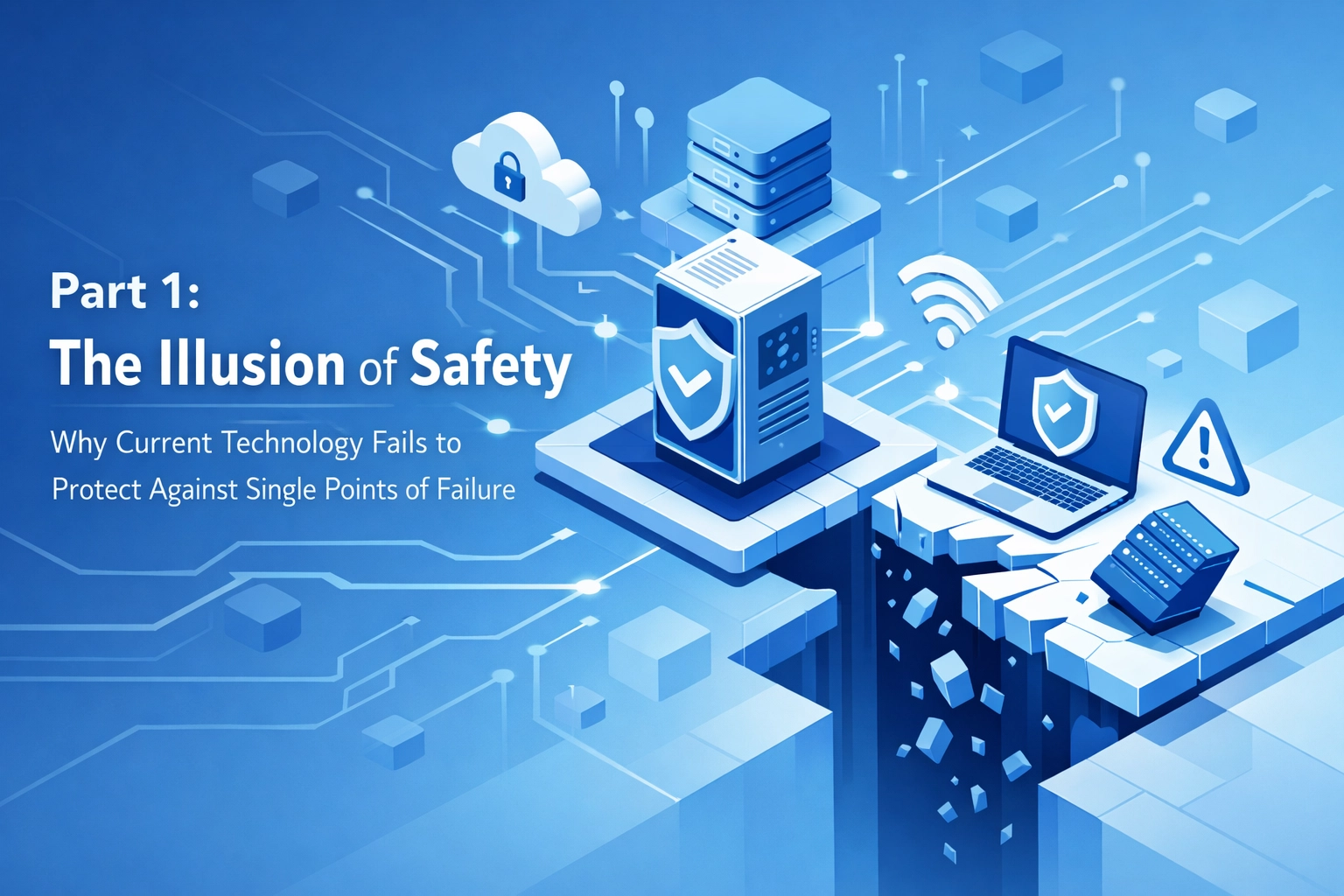
The Comfortable Lie We Keep Telling Ourselves
Every CISO sleeps a little easier knowing their organization has invested millions in cybersecurity infrastructure. Firewalls? Check. Endpoint protection? Deployed across the enterprise. Zero-trust architecture? In progress. Multi-factor authentication? Mandatory for all users.
Yet despite these investments, organizations continue to experience catastrophic breaches. According to IBM's 2025 Cost of a Data Breach Report, the average cost of a data breach reached $4.88 million, with detection and escalation taking an average of 204 days. The question isn't whether current technology works: it's whether it addresses the fundamental architectural flaw that undermines every security strategy: single points of failure.
The uncomfortable truth is that modern cybersecurity infrastructure, for all its sophistication, is built on a foundation that guarantees vulnerability. We've created an illusion of safety while systematically designing systems that fail catastrophically when: not if: a single component is compromised.
The Architecture of Vulnerability
Traditional cybersecurity operates on a perimeter defense model. Organizations invest heavily in fortifying their boundaries: next-generation firewalls, intrusion detection systems, secure email gateways, and web application firewalls. According to Gartner's 2025 Security and Risk Management Report, global spending on security and risk management is projected to reach $267.3 billion, yet breach frequency and severity continue to escalate.
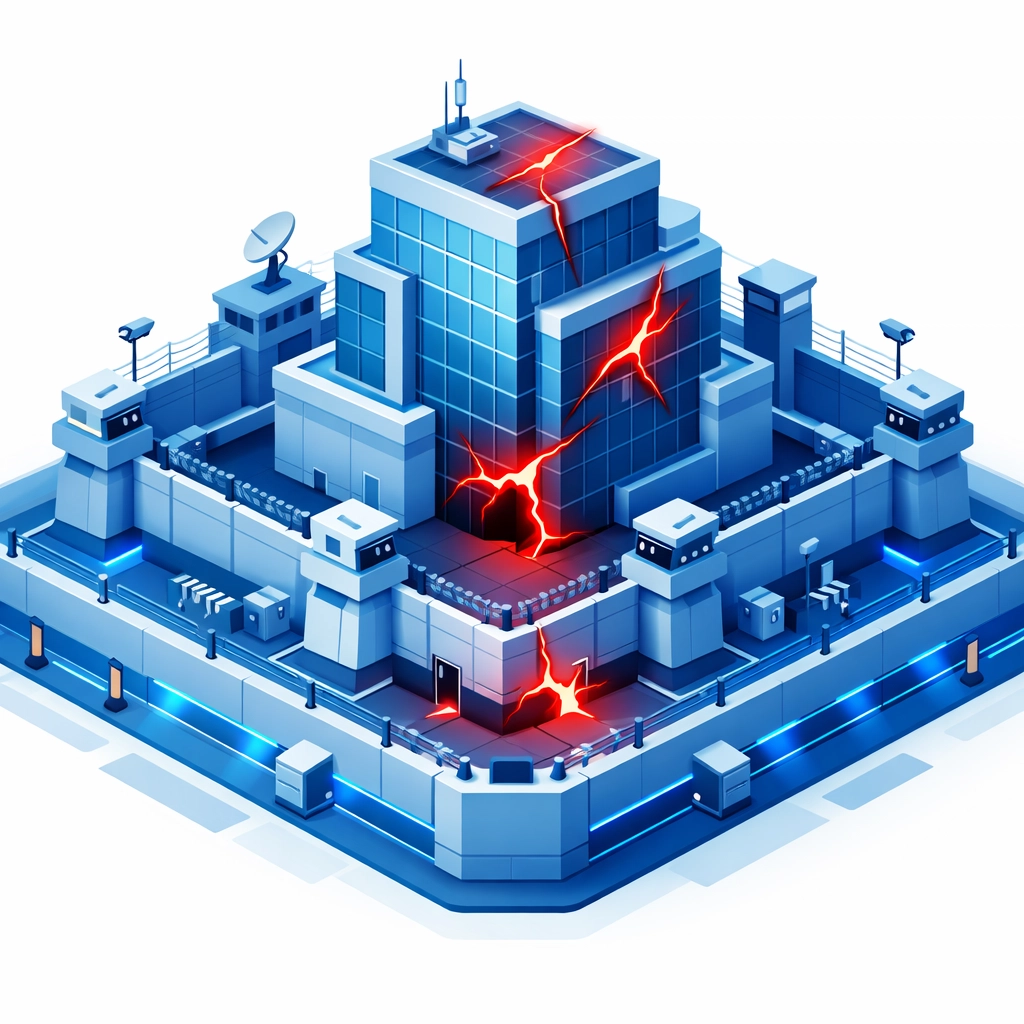
The fundamental problem lies not in the efficacy of individual security tools but in their architectural deployment. Each security layer: no matter how advanced: represents a potential single point of failure. When an attacker bypasses the perimeter (through phishing, stolen credentials, or zero-day exploits), they gain access to everything behind it. The castle-and-moat approach assumes the moat is impenetrable, but history demonstrates otherwise.
Consider the authentication layer. Multi-factor authentication has become the gold standard for access control, reducing account compromise risk by 99.9% according to Microsoft's security intelligence. Yet MFA itself introduces single points of failure: centralized authentication servers, credential storage databases, and recovery mechanisms. When authentication infrastructure is compromised: as seen in the 2024 Okta breach affecting thousands of organizations: the entire security model collapses.
The Centralization Trap
The migration to cloud infrastructure has paradoxically increased single point of failure risks while promising improved resilience. Organizations have consolidated their infrastructure with major cloud providers, creating massive concentration risk. Deloitte's 2025 Cloud Security Survey found that 78% of enterprises now rely on a single primary cloud provider for mission-critical applications.
This centralization creates systemic vulnerabilities. When AWS experienced a major outage in December 2025 affecting the us-east-1 region, thousands of organizations simultaneously lost access to critical systems. The irony is palpable: organizations adopted cloud infrastructure to improve resilience and eliminated geographic single points of failure, only to create logical single points of failure at the provider level.
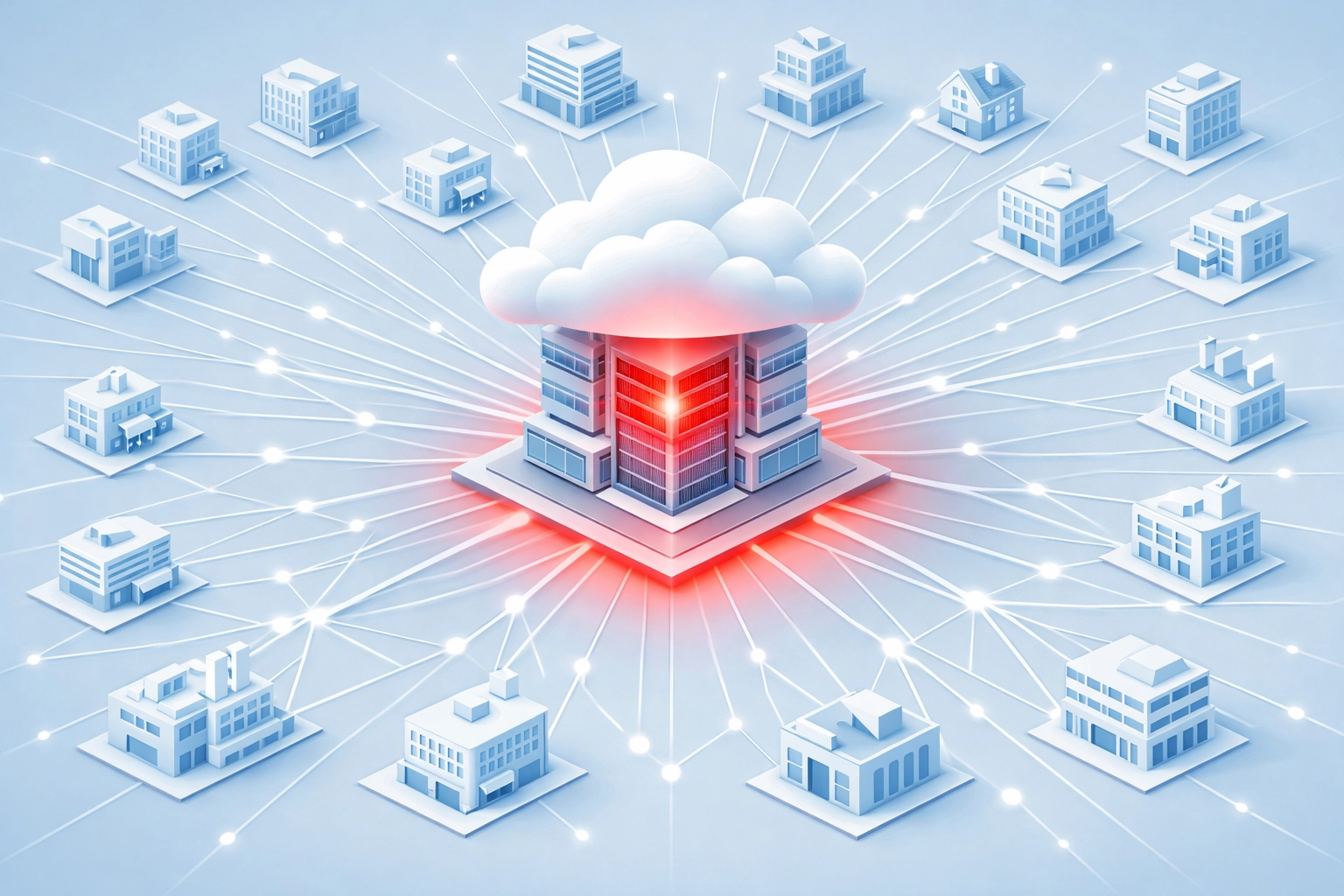
The problem extends beyond infrastructure availability. Cloud identity and access management systems represent centralized control planes for entire organizations. Compromise a cloud admin account or the IAM system itself, and an attacker gains systematic access to every resource. PwC's 2025 Global Digital Trust Insights found that 41% of organizations experienced a cloud-related security incident in the past year, with misconfigured access controls being the leading cause.
The Data Encryption Fallacy
Encryption has become synonymous with data security. Organizations encrypt data at rest, in transit, and increasingly during processing. Yet traditional encryption models introduce their own single points of failure: centralized key management systems.
Every encrypted file, database, or communication stream depends on cryptographic keys stored in key management infrastructure. Compromise the key management system: through insider threat, supply chain attack, or infrastructure vulnerability: and every encrypted asset becomes accessible. The 2025 KPMG Cybersecurity Report documented 23 major incidents involving key management system compromises, affecting over 190 million records.
This centralized key dependency creates an attractive target for sophisticated attackers. Rather than attempting to crack encryption algorithms (computationally infeasible with modern standards), adversaries target the key management infrastructure itself. It's the equivalent of building an impenetrable vault but leaving the combination in a desk drawer.
The Human Element: The Ultimate SPOF
Technology vulnerabilities are compounded by organizational single points of failure. According to Accenture's 2025 State of Cybersecurity Resilience Report, 43% of organizations identified "key person dependencies" as a critical risk factor, yet only 12% had implemented effective mitigation strategies.
Consider the typical enterprise security architecture: a handful of senior engineers understand the complete security infrastructure. They maintain the firewalls, manage the SIEM, configure the cloud security controls, and respond to incidents. When one of these individuals leaves the organization: or becomes unavailable during a critical incident: organizational security capabilities degrade dramatically.

This human single point of failure extends to decision-making authority. Many organizations concentrate security authority in the CISO role without establishing clear succession planning or distributed decision-making frameworks. During rapidly evolving incidents requiring immediate response, the absence of authorized decision-makers can mean the difference between containment and catastrophic breach.
The Compliance Theater Problem
Regulatory frameworks and compliance standards promise to address security vulnerabilities through mandatory controls and regular audits. Organizations invest substantial resources achieving SOC 2, ISO 27001, HIPAA, or PCI DSS compliance. Yet compliance rarely eliminates single points of failure: it often codifies them.
Compliance frameworks typically require centralized logging, monitoring, and access control systems. These become single points of failure: compromise the SIEM, and the organization loses visibility; bypass the centralized access control, and lateral movement becomes trivial. Ernst & Young's 2025 Global Information Security Survey found that 68% of organizations that experienced breaches were compliant with relevant standards at the time of the incident.
The problem isn't that compliance is worthless: it establishes baseline security practices. The problem is treating compliance as equivalent to security. Organizations check the boxes, pass the audits, and assume they're protected, while the fundamental architectural vulnerabilities remain unaddressed.
The Supply Chain Multiplication Effect
Modern organizations don't operate in isolation. They depend on software vendors, cloud providers, managed service providers, and various third-party integrations. Each dependency introduces potential single points of failure that multiply across the ecosystem.
The 2024 SolarWinds attack demonstrated how supply chain compromise can cascade across thousands of organizations. By compromising a single software update mechanism: a clear single point of failure: attackers gained access to 18,000 organizations. McKinsey's 2025 Cybersecurity State of the Market Report found that 62% of breaches involved third-party or supply chain vulnerabilities.
Organizations have limited visibility into their vendors' security architectures and little ability to eliminate single points of failure in third-party systems. Contractual requirements and vendor assessments provide some assurance, but they cannot eliminate the fundamental risk of dependency on external single points of failure.
Where Traditional Technology Falls Short
The cybersecurity industry has responded to these challenges with incrementally better versions of the same architectural approach. Next-generation firewalls add more inspection capabilities but remain perimeter-focused. Extended detection and response (XDR) platforms correlate more telemetry but depend on centralized collection and analysis. Zero-trust network access distributes the perimeter but still relies on centralized policy enforcement.

These improvements are valuable but insufficient. They address symptoms without resolving the underlying architectural flaw: centralized control and single points of decision-making, authentication, encryption, and enforcement.
Bass Zanjani, Interim CEO of VeeKrypt, puts it bluntly: "The industry has spent decades optimizing a fundamentally flawed architecture. We've built increasingly sophisticated defenses around critical chokepoints, but we haven't eliminated the chokepoints themselves. True security requires rethinking the architecture from the ground up: distributing trust, decentralizing control, and eliminating single points of failure at every layer."
The Way Forward
The solution isn't abandoning current security tools: it's reimagining the architectural foundation. Technologies like blockchain-based distributed ledgers, cloud overlay encryption, and AI-powered decentralized threat detection offer paths toward eliminating single points of failure rather than simply fortifying them.
Cloud overlay encryption, for example, separates encryption key management from cloud infrastructure, eliminating the single point of failure inherent in provider-managed encryption. By distributing key material and policy enforcement across multiple independent systems, organizations can maintain security even when individual components are compromised.
VeeKrypt's approach, leveraging CloudFish technology, demonstrates how distributed security architectures can eliminate traditional single points of failure. By implementing blockchain-based authentication, distributed key management, and decentralized policy enforcement, organizations can achieve resilience that doesn't depend on any single component remaining secure.
This Is Only the Beginning
This article is Part 1 of our three-part series on single points of failure. We've identified why current technology fails to protect against SPOFs: not because individual tools are ineffective, but because the underlying architecture guarantees vulnerability.
In Part 2, we'll explore the hidden risks in infrastructure: how cloud dependencies, centralized systems, and architectural blind spots create invisible vulnerabilities that even sophisticated security teams overlook.
Part 3 will examine how distributed architectures, cloud overlay encryption, and blockchain-based security models can eliminate single points of failure and establish genuinely resilient security postures.
Ready to eliminate single points of failure in your security architecture? The team at VeeKrypt specializes in implementing distributed security models that don't depend on any single component remaining secure. Book a demo or contact us for a comprehensive security assessment that identifies and addresses your organization's critical single points of failure. Don't wait for the inevitable compromise( build resilience into your architecture today.)





 Faisal Faruqi is a serial entrepreneur and long-time Silicon Valley veteran with over two decades of experience spanning enterprise software, mobility, and cybersecurity. He spent thirteen years at Oracle Corporation, where he contributed as one of the architects of Oracle’s flagship e-Business Suite, a platform serving millions of users worldwide. In 2010, Faisal launched his first startup in enterprise mobility, achieving notable success before devoting the past decade to pioneering research and innovation in cybersecurity. He holds a master’s degree in Computer Science and Engineering from the University of Florida. Outside of technology, Faisal is a passionate philosopher and poet, currently authoring a book that brings together his poetic works and explores his deep reflections on the human condition and the pursuit of meaning.
 With over 29 years of experience in information security and compliance, Adam Nunn is a seasoned professional who has held roles as Chief Information Security Officer (CISO) and Chief Compliance Officer, focusing on the intersection of regulatory compliance and cybersecurity. Specializing in developing robust cybersecurity programs aligned with frameworks such as NIST, ISO, CIS, and HIPAA, Adam has overseen and coordinated information security initiatives for hundreds of entities across the United States and provided services worldwide, including in Europe, Asia, South America, and North America.
 Sujit Maharana is a seasoned technology executive with more than two decades of experience leading global engineering, cloud, and security organizations. He has served as a Chief Information Security Officer (CISO) and senior engineering leader in the SaaS industry, where he has built and scaled secure, cloud-native platforms used by millions of users worldwide.